
Payment Methods at UK Online Casinos: Your 2026 Guide to Deposits and Withdrawals
 Available in GB
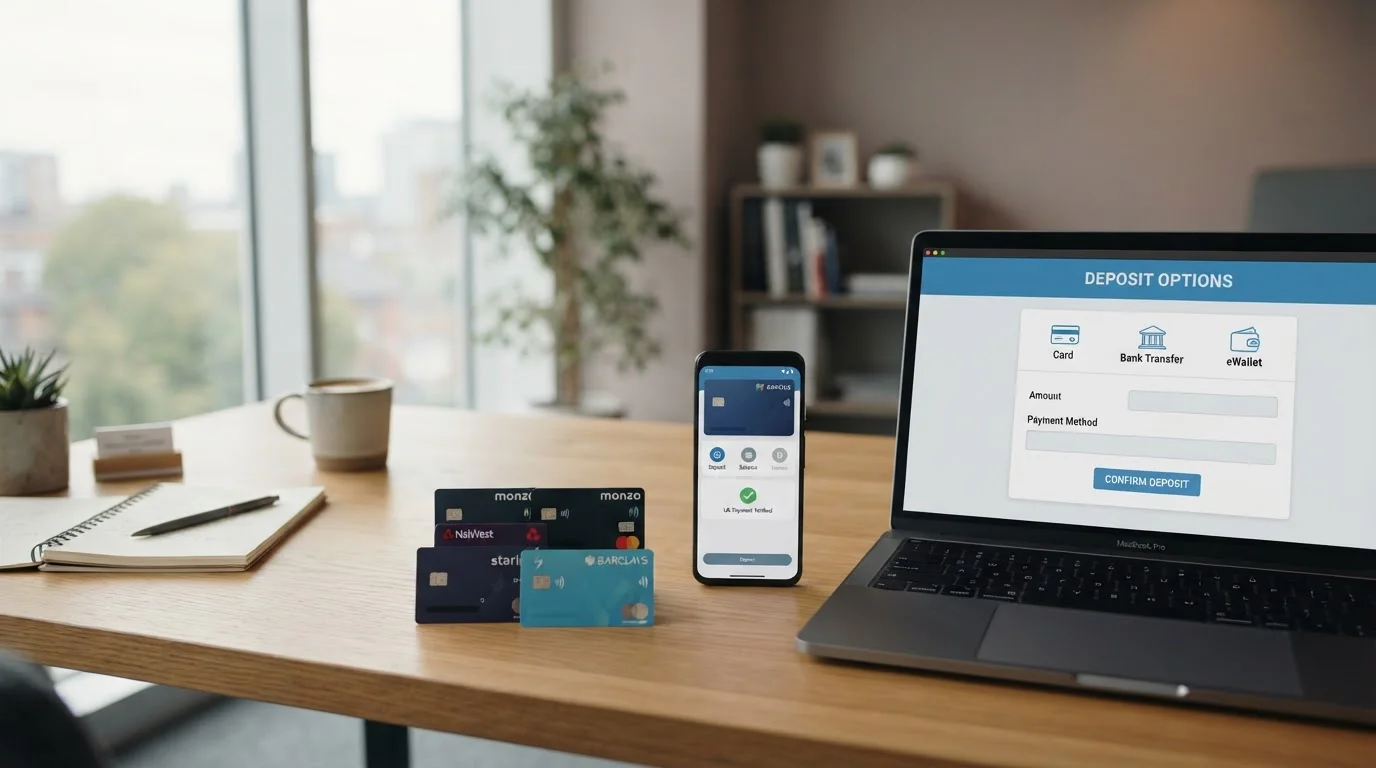
Choosing the right payment method at a UK online casino determines how quickly you can start playing and how fast your winnings reach your bank account. Since April 2020, the UK Gambling Commission has reshaped what works and what doesn’t: credit cards are banned, e-wallets face funding restrictions, and new instant banking options have emerged. This guide maps every legitimate deposit and withdrawal method available at UKGC-licensed casinos in 2026, explaining how each one works in practice and which suits your priorities.
The UK market offers five main payment categories: debit cards (Visa and Mastercard), e-wallets and mobile wallets (PayPal, Skrill, Neteller, plus Apple Pay and Google Pay), bank transfers (instant Open Banking via Trustly and traditional transfers), mobile payments (Boku and phone-bill deposits), and prepaid vouchers (Paysafecard). Each category differs in deposit speed, withdrawal timing, minimum limits, fees, and bonus eligibility. Understanding these differences helps you choose the method that fits whether you prioritise instant deposits, fastest withdrawals, lowest minimums, or privacy.
UK Online Casino Payment Methods: What’s Legal in 2026
The UK Gambling Commission regulates online gambling through the Gambling Act 2005 and the Licence Conditions and Codes of Practice (LCCP). Section 5.1 of the LCCP governs payment methods, and its 2020 amendment fundamentally changed the UK casino payment landscape.
Credit cards are banned for online gambling deposits at all UKGC-licensed operators. The ban took effect on 14 April 2020, covering Visa, Mastercard and American Express credit cards. The UKGC introduced this rule to prevent problem gambling funded by borrowed money. Only debit cards and prepaid cards are permitted for card-based deposits.
The ban extends beyond credit cards themselves. The LCCP binds licensed operators, not payment companies, so it is the casino that must not accept a deposit made through an e-wallet or other payment service if that payment is funded by a credit card. In practice, PayPal, Skrill, Neteller and other wallets used at UKGC casinos block credit-card funding for gambling transactions, so deposits come from debit-card or bank-funded balances. This closes the obvious loophole of loading a wallet with credit card funds and then depositing from it.
In practice, UKGC-licensed casinos do not accept cryptocurrency payments. The Gambling Commission does not ban crypto outright, but its anti-money-laundering and source-of-funds requirements mean licensed operators do not offer Bitcoin, Ethereum or other coins in their cashiers. Sites licensed in other jurisdictions, such as Curaçao, may promote crypto payments to UK players, but they do not hold UKGC licences, are not part of GAMSTOP and lie outside UK consumer protection. This guide covers only UKGC-licensed operators and the payment methods they offer.
| Payment Category | Deposit Speed | Withdrawal Speed | Typical Limits | Availability | Key Features |
|---|---|---|---|---|---|
| Debit Cards | Instant | 1–5 working days | £1–£10 min | Universal (every UKGC casino) | Default standard; no separate registration |
| E-Wallets | Instant | 12–48 hours | £5–£10 min | Wide (~40–80 casinos for PayPal/Skrill) | Fastest withdrawals; privacy layer |
| Bank Transfers | Instant (Open Banking) or up to 3 working days to be credited (manual) | Under 1 hour (Open Banking) or 3–7 working days (manual) | £10–£100 min | Most operators | Highest maximums; no wallet needed |
| Mobile Payments | Instant | N/A (deposit-only) | £5–£10 min; £30 max per transaction | ~64 casinos (Boku) | Phone bill charging; no bank details shared |
| Prepaid Vouchers | Instant | N/A (deposit-only) | £10–£100 typical | Select operators | Maximum privacy; cash-purchased |
The table above summarises the five legal payment categories. The remainder of this guide breaks down each category in detail, explains which specific methods work best for different priorities, and provides the withdrawal timelines and minimum deposit floors you will encounter in practice.
Are crypto payments accepted at UKGC-licensed UK casinos?
In practice, no. Licensed operators do not offer cryptocurrency deposits or withdrawals because of the Gambling Commission’s strict anti-money-laundering and source-of-funds requirements. Sites that do take crypto from UK players operate without a UKGC licence, outside GAMSTOP and without UK dispute resolution or safer gambling safeguards, which leaves you with little recourse.
Debit Cards: The Universal Standard
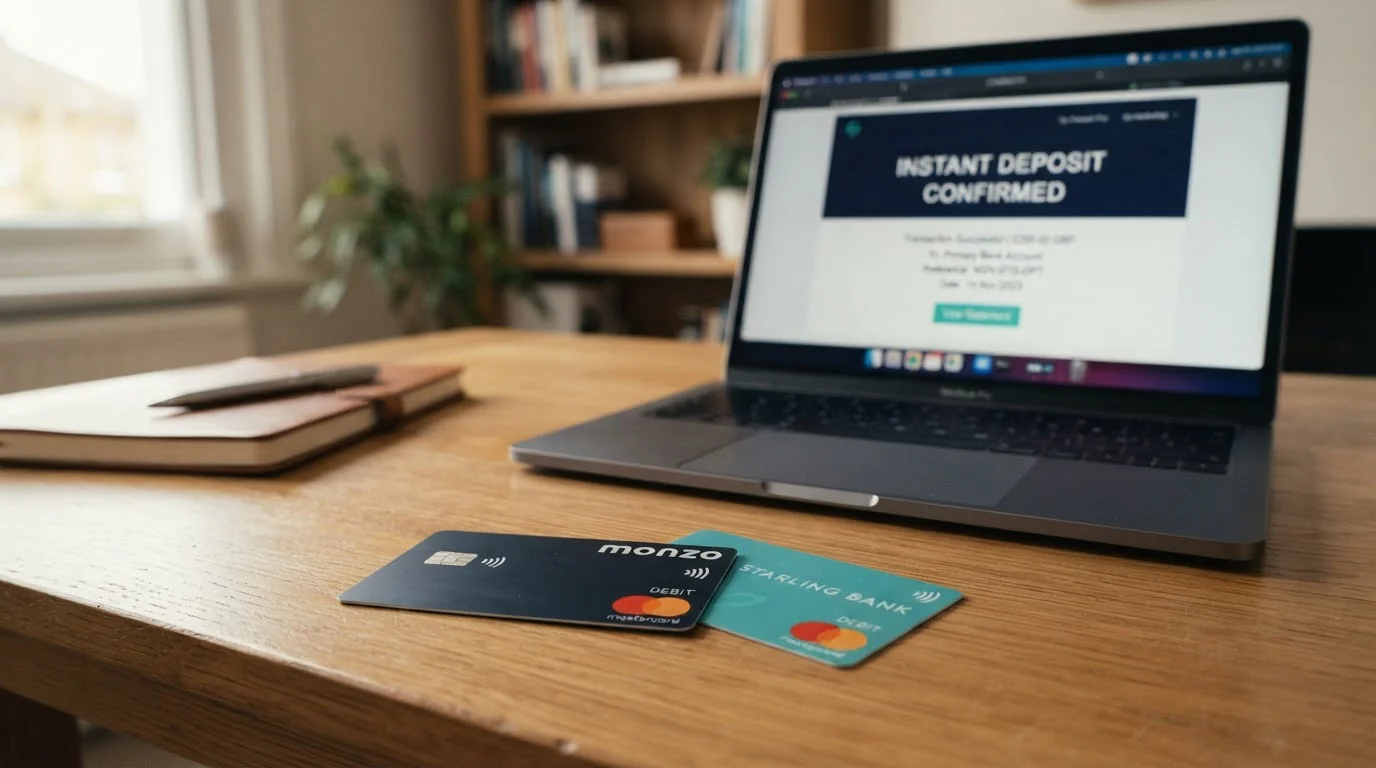
Debit cards issued by UK banks on the Visa and Mastercard networks are accepted at every UKGC-licensed casino. This universal acceptance makes debit cards the default payment method for the majority of UK players. If you hold a UK bank account, your debit card works without any separate registration or wallet setup.
Visa and Mastercard: How They Work at UK Casinos
When you deposit with a debit card, the casino processes the transaction through the Visa or Mastercard payment network. You enter your 16-digit card number, expiry date, and three-digit security code (CVV) in the casino cashier. The deposit clears in seconds and your casino balance updates instantly. The charge appears on your bank statement as the casino’s merchant name.
Withdrawals return to the same debit card you deposited from. The casino sends funds back through the card network, and the money lands in your bank account linked to that card. Withdrawal times range from one to five working days, with most UKGC operators processing debit card withdrawals within two to three working days. The delay comes from card network clearing time, not the casino; once the casino approves your withdrawal, the card network handles the transfer.
Minimum deposit limits for debit cards typically range from £1 to £10 depending on the operator. bet365, Paddy Power, William Hill, Ladbrokes and Betfred set a £5 minimum for debit card deposits. DragonBet offers a £1 minimum, one of the lowest floors in the UK market. Maximum deposits are operator-specific but often reach £10,000 to £50,000 per transaction at major casinos.
There are no player fees for debit card deposits or withdrawals at UKGC-licensed casinos. The operator absorbs the payment processing cost, which typically runs 1.5% to 2.5% per transaction on the casino’s side. Your bank may charge foreign transaction fees if you deposit at a casino processing payments through a non-UK merchant, but domestic UK casino transactions are free.
Age and identity verification comes before your first deposit. Since May 2019, UKGC operators must verify your age and identity before you can deposit or gamble, usually through automatic checks at registration, with a photo ID or proof of address requested only if those checks fail. Before paying out, the casino may still ask you to prove the card is yours, typically with a photo showing the first six and last four digits and the middle digits masked.
Debit cards qualify for welcome bonuses at virtually all UK casinos, which makes them the most straightforward choice for players claiming a first deposit bonus.
Maestro Phase-Out: What UK Players Need to Know
Maestro debit cards, historically common in the UK, are being phased out. Mastercard discontinued issuing new Maestro cards in the UK from July 2023, transitioning customers to Mastercard-branded debit cards instead. Existing Maestro cards continue to work at online casinos until their expiry date, but once your card expires, your bank will issue a Mastercard debit card as the replacement.
This phase-out does not affect your ability to deposit or withdraw. Mastercard debit cards function identically to Maestro at UK casinos: instant deposits, withdrawals in two to three working days, universal acceptance. If you currently use a Maestro card and it still has time before expiry, it will continue working. When you receive your replacement Mastercard debit card, update your payment details in the casino cashier at your next deposit.
How long do debit card withdrawals take?
Debit card withdrawals typically take two to three working days from the moment the casino approves your request. Any pending period (0 to 48 hours, depending on the operator) comes first, then approval, then card network clearing. A first withdrawal can take longer if the casino asks for proof of card ownership before paying out.
E-Wallets: Speed and Privacy
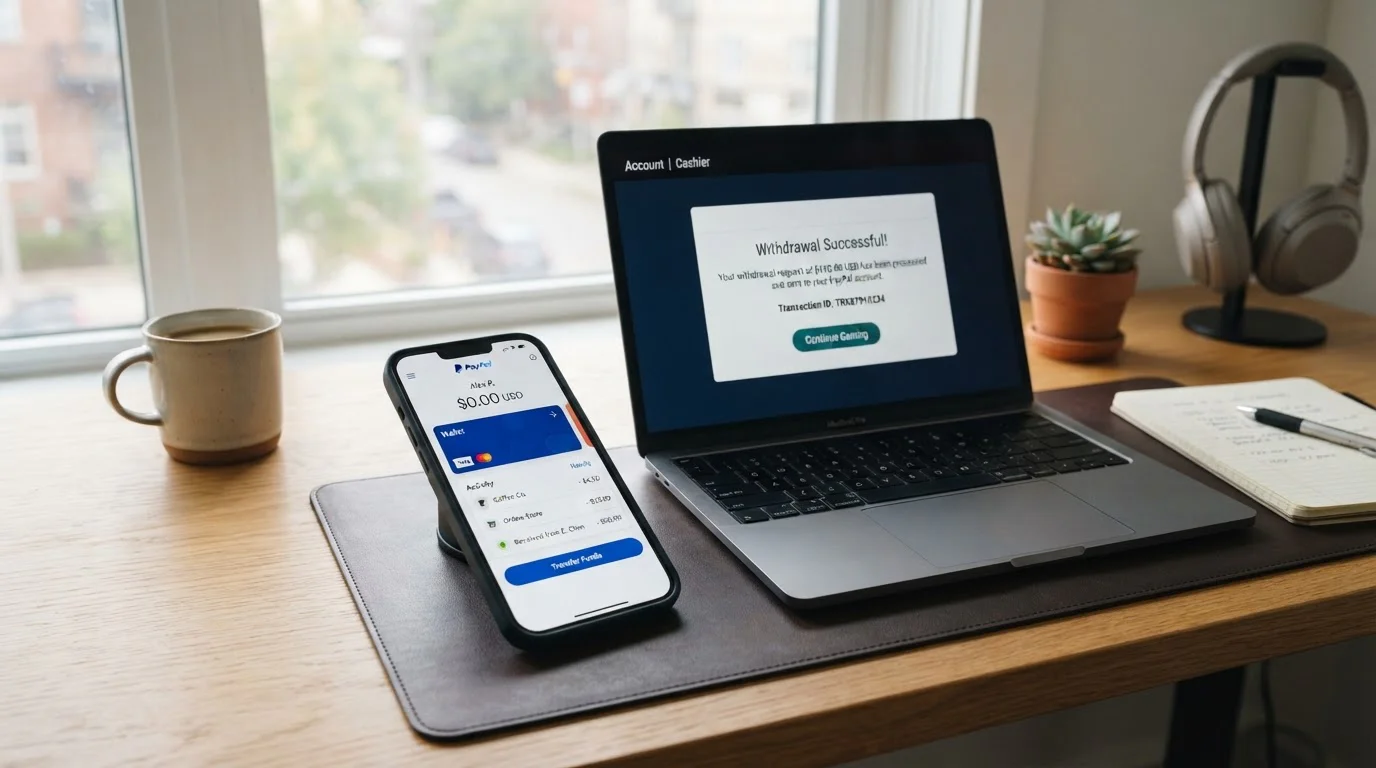
E-wallets offer the fastest withdrawal times in the UK casino market and add a privacy layer: the casino never sees your bank account or card details. PayPal, Skrill, Neteller and MuchBetter act as intermediaries between your bank and the casino: you deposit from your wallet balance, withdrawals return to that balance, and you then transfer the money to your bank separately. Apple Pay and Google Pay are covered in this section because they sit in the same part of the cashier, but they work differently. They are mobile payment layers over your debit card rather than wallets with a balance, so withdrawals go back to the card.
The main advantage of a true e-wallet is speed. E-wallet withdrawals typically land within 12 to 48 hours of your request, with PayPal usually at the quicker end and Skrill and Neteller nearer 24 to 48 hours, compared with two to three working days for debit cards. This makes e-wallets the default choice for players prioritising fast access to winnings.
The main disadvantage is bonus exclusion. Skrill and Neteller deposits are excluded from welcome bonuses at most UK operators. This industry-wide pattern dates from a time when some players cycled funds between e-wallets and casinos to farm bonuses with little risk. PayPal and Apple Pay do not usually face the same exclusion, so bonus eligibility depends on which wallet you choose.
| E-Wallet | Withdrawal Speed | Fees | Bonus Eligibility | Minimum Deposit | UKGC Casino Acceptance |
|---|---|---|---|---|---|
| PayPal | 12–24 hours | None for player | Typically qualifies | £5–£10 | ~40 casinos |
| Skrill | 24–48 hours | 1.45% currency conversion; £1 instant bank withdrawal | Usually excluded | £5–£10 | ~80+ casinos |
| Neteller | 24–48 hours | 1.50% currency conversion | Usually excluded | £5–£10 | ~70+ casinos |
| Apple Pay | 1–5 working days (to underlying debit card) | None for player | Typically qualifies | £1–£10 | Growing (30+ casinos) |
| Google Pay | 1–5 working days (to underlying debit card) | None for player | Typically qualifies | £5–£10 | Limited (20+ casinos) |
| MuchBetter | 24–48 hours | Varies by transaction | Usually excluded | £10 | ~40 casinos |
PayPal: The Most Trusted E-Wallet for UK Casinos
PayPal is the most widely recognised e-wallet in the UK, and that brand trust extends to online gambling. Around 40 UKGC-licensed casinos accept PayPal as of 2026, including major operators like PokerStars, BetMGM, Paddy Power, William Hill and bet365.
PayPal deposits clear immediately. You log in to your PayPal account via the casino cashier, authorise the payment, and your casino balance updates within seconds. The casino never sees your bank details or card number; PayPal processes the transaction and the charge appears as the merchant name on your PayPal statement.
Withdrawals to PayPal are among the fastest options at most UK casinos. PayPal payout times at UKGC-licensed operators range from under an hour at the quickest to around 72 hours at the slowest, with 12 to 24 hours from withdrawal request to funds landing in the PayPal balance being typical. BetMGM and PokerStars are among the operators that often process PayPal withdrawals within a few hours.
Once funds land in your PayPal balance, you transfer them to your linked UK bank account. PayPal offers instant transfer to some UK banks (the money arrives in seconds if your bank supports PayPal Instant Transfer) or a standard transfer, which takes about one working day. The instant option carries a small fee; standard transfer is free.
Minimum deposits at PayPal casinos typically range from £5 to £10. bet365, Paddy Power and William Hill all set a £5 minimum for PayPal, and there are no player fees for deposits.
PayPal deposits typically qualify for welcome bonuses. This makes PayPal the preferred e-wallet for players claiming a first deposit bonus while still benefiting from faster withdrawals than debit cards. One point worth knowing: PayPal’s Buyer Protection does not cover gambling transactions, so it is no substitute for the casino’s own complaints process.
PayPal holds authorisation from the Financial Conduct Authority (FCA) as an electronic money institution. Because UKGC casinos must not accept credit-funded wallet deposits, PayPal blocks credit-card funding for gambling transactions: you cannot load your balance with a credit card and then deposit to a casino. Deposits must come from a balance funded by debit card or bank transfer.
Skrill: Fast Withdrawals with a Bonus Catch
Skrill is an e-wallet owned by Paysafe Group, the same company that owns Neteller and Paysafecard. Founded in 2001 as Moneybookers and rebranded to Skrill in 2011, it is one of the longest-established e-wallets in the online gambling industry. Skrill is accepted at more than 80 UKGC-licensed casinos, giving it wider availability than PayPal.
Deposits work like any e-wallet: you fund your Skrill account from your bank or debit card, then deposit from your Skrill balance to the casino, where the funds appear straight away. Withdrawals return to your Skrill balance, typically within 24 to 48 hours of your request; most of that time is the casino’s own pending and approval period, as the transfer to the wallet itself is near-instant. Once in your Skrill balance, you transfer funds to your UK bank account. Skrill offers instant withdrawal from the wallet to your bank for a £1 fee, or a free standard transfer, which takes one to two working days.
Skrill charges a 1.45% currency conversion fee if your transaction involves currency exchange (for example, depositing GBP to a casino processing in EUR). Domestic GBP-to-GBP transactions are free for the player, and the £1 instant bank withdrawal fee is optional if you are happy to wait for a standard transfer.
Skrill deposits are excluded from welcome bonuses at most UK casinos. This is the major catch. Operators including bet365, William Hill, Ladbrokes, Coral and most others explicitly exclude Skrill from first deposit bonus eligibility. If you plan to claim a welcome bonus, PayPal or a debit card is the better choice. Skrill works best for regular players who no longer need bonuses and prioritise withdrawal speed.
Skrill is authorised by the FCA and, like PayPal, blocks credit-card funding for gambling, so you cannot top up your Skrill account with a credit card and then deposit at a UKGC casino. Minimum deposits at Skrill-accepting casinos typically range from £5 to £10, the same as PayPal.
Neteller: Skrill’s Sister Service
Neteller is Skrill’s sister product within the Paysafe Group portfolio. Both were established in the late 1990s and early 2000s as e-wallet solutions for online gambling, and both function nearly identically. Neteller was founded in 1999, two years before Skrill.
The mechanics are the same: fund your Neteller account from your bank or debit card, deposit from Neteller to the casino (instant), withdraw back to Neteller (typically 24 to 48 hours from your request), then transfer from Neteller to your bank. Neteller charges a 1.50% currency conversion fee, marginally higher than Skrill’s 1.45%. Otherwise, the two wallets are functionally identical.
Neteller deposits are also excluded from welcome bonuses at most UK casinos. The same bonus exclusion that applies to Skrill applies to Neteller. If claiming a welcome bonus matters, use PayPal or a debit card. If you are a regular player focused on withdrawal speed and already have a Neteller account, it works just as well as Skrill.
Neteller is accepted at around 70 UKGC-licensed casinos, slightly fewer than Skrill’s 80+ but still broad coverage. Like Skrill, it is authorised by the FCA and blocks credit-card funding for gambling. Minimum deposits are £5 to £10 depending on the operator.
Choosing between Skrill and Neteller comes down to which you already have an account with, or the 0.05 percentage-point difference in currency conversion fees (Skrill 1.45% vs Neteller 1.50%). For practical purposes, they perform identically in the UK casino context.
What is the fastest withdrawal method at UK online casinos?
Open Banking via Trustly and PayPal are usually the fastest, with Trustly payouts often landing in under an hour and PayPal typically within 12 to 24 hours. Skrill and Neteller generally take 24 to 48 hours from request. Debit cards take two to three working days, and manual bank transfers three to seven.
Why are Skrill and Neteller often excluded from casino bonuses?
These wallets let players move money between casinos with very little friction, which historically enabled bonus abuse: deposit, claim a bonus, withdraw if it did not convert favourably, then repeat. Casinos responded by excluding Skrill and Neteller deposits from welcome offers. PayPal and Apple Pay are usually treated differently, so check each offer’s terms.
Apple Pay: Seamless Mobile Deposits
Apple Pay is a mobile payment service integrated into iPhones, iPads, Apple Watches and Macs. It uses near-field communication (NFC) for contactless payments and biometric authentication (Face ID or Touch ID) for security. When you deposit at a UK casino using Apple Pay, the transaction processes as a debit card payment through the Visa or Mastercard network of the card you have linked to your Apple Wallet.
You select Apple Pay in the casino cashier, authenticate with Face ID or Touch ID, and the deposit clears in seconds. There is no need to type card details; Apple Pay automatically uses the card linked to your Apple Wallet. The casino sees an Apple Pay transaction but not your actual card number, adding a privacy layer.
Withdrawals return to the underlying debit card you deposited with, not to Apple Pay itself, because Apple Pay is a mobile payment layer over your card rather than a wallet that holds a balance. Withdrawal times are therefore identical to standard debit card withdrawals: two to three working days from casino approval. That is slower than PayPal or Skrill, but faster than traditional bank transfers.
Minimum deposits for Apple Pay vary by operator. DragonBet offers a £1 minimum for Apple Pay, the lowest we have found in the UK market. bet365, William Hill, Paddy Power and most major operators set a £5 minimum, and there are no player fees.
Apple Pay deposits typically qualify for welcome bonuses. Because Apple Pay processes as a debit card transaction, it is not normally caught by the Skrill and Neteller exclusion, so you get quick mobile deposits without giving up bonus eligibility.
Adoption is growing. As of 2026, Apple Pay is accepted at more than 30 UKGC-licensed casinos including BetMGM, LeoVegas, 10Bet, bet365, Paddy Power and William Hill. Coverage is not yet universal like debit cards, but it is expanding steadily. If your preferred casino accepts Apple Pay and you use an iPhone, it offers the most seamless deposit experience: biometric authentication, no typing, instant clearing.
Apple Pay is not a financial institution; it is a technology layer on top of your existing debit card. Your bank issues the card, and Apple Pay securely transmits the payment. This means Apple Pay deposits are subject to the same credit card ban as card payments: a UKGC casino will only accept them from a linked debit card or prepaid card, never a credit card.
Google Pay and MuchBetter: Alternative Options
Google Pay and MuchBetter round out this part of the cashier. Both work at UKGC-licensed casinos, but with narrower acceptance than PayPal or Skrill.
Google Pay functions similarly to Apple Pay: it is a mobile payment technology that processes transactions through the Visa or Mastercard network of the debit card linked to your Google account. Deposits are instant via biometric or PIN authentication. Withdrawals return to the underlying debit card (two to three working days). Google Pay is accepted at around 20 UKGC-licensed casinos as of 2026, fewer than Apple Pay but growing. Minimum deposits are typically £5 to £10. Google Pay deposits generally qualify for bonuses because the transaction processes as a debit card payment.
MuchBetter is a standalone e-wallet app designed specifically for online gambling. It functions like Skrill or Neteller: you load your MuchBetter account from a debit card or bank transfer, deposit from the app to the casino (instant), and withdraw back to the app (24 to 48 hours). MuchBetter is accepted at around 40 UKGC-licensed casinos. Minimum deposits are typically £10, fees vary by transaction type and, like Skrill and Neteller, MuchBetter deposits are often excluded from welcome bonuses.
MuchBetter targets mobile-first players and offers features like touchscreen pattern login instead of passwords. If you already use MuchBetter and your casino accepts it, withdrawal times are comparable to Skrill. For players without an existing MuchBetter account, PayPal or Skrill offer broader casino acceptance and similar performance.
Bank Transfers and Open Banking
Bank transfers fall into two categories: instant Open Banking (via Trustly or Pay by Bank) and traditional manual bank transfers. The two methods share a name but differ fundamentally in deposit speed, withdrawal speed, and user experience.

Trustly and Open Banking: Instant Bank-to-Casino Payments
Trustly is a payment provider that uses Open Banking technology to connect your bank account directly to the casino. Open Banking is a regulatory framework enabled by the UK Payment Services Regulations 2017 (which implemented the EU’s PSD2), allowing third-party payment providers to access your bank account with your authorisation.
When you deposit via Trustly, you select your bank from a list in the casino cashier, then log in to your online banking portal using your regular banking credentials. You authorise the payment, and funds transfer instantly from your bank account to the casino. There is no separate Trustly account or wallet; Trustly acts as a secure intermediary facilitating the transfer.
The casino balance updates within seconds, just like a debit card deposit. The difference is that Trustly pulls funds directly from your bank account rather than processing through a card network, so there is no need to enter card details. The charge appears on your bank statement as the casino’s merchant name or “Trustly payment”.
Withdrawals via Trustly are among the fastest available, rivalling PayPal. Trustly payouts typically clear within one hour at the fastest UKGC operators, and within 24 hours at most others. This makes Trustly comparable to or faster than e-wallets for withdrawals, without requiring a separate wallet account.
There are no player fees for Trustly deposits or withdrawals. Minimum deposits are typically £10, slightly higher than PayPal or debit cards. Maximum deposits are operator-specific but can reach high limits; some casinos accept Trustly deposits up to £50,000 or more in a single transaction.
Trustly and Open Banking deposits typically qualify for welcome bonuses because they process as direct bank payments, which gives Trustly an advantage over Skrill and Neteller for bonus-claiming players.
Trustly is an independent Swedish company, founded in 2008, and is authorised in the UK by the FCA as a payment institution. It operates in more than 30 European countries. Around 50 to 60 UKGC-licensed casinos accept Trustly as of 2026, including major operators like Betfred, Casumo and Grosvenor. Some casinos label it “Trustly”, others “Pay by Bank” or “Instant Bank Transfer”; these are all the same Open Banking mechanism.
What’s the difference between Trustly and a traditional bank transfer?
Trustly uses Open Banking, so the casino credits the payment instantly, and withdrawals often land within an hour. With a manual transfer, the Faster Payment itself arrives within minutes, but the casino must match it to your account by hand, which can take up to three working days; payouts take three to seven.
Traditional Bank Transfer: When to Use It
Traditional bank transfer means manually sending a payment from your online banking to the casino’s bank account. The casino provides its account number, sort code and a payment reference, you log in to your online banking separately, add the casino as a payee and send the transfer. Faster Payments move the money almost instantly, but the casino has to identify and credit it manually, so your balance may not update for anything from a few hours to three working days.
This makes it the slowest deposit option in practice. Debit cards, e-wallets, Trustly, Apple Pay and mobile payments all credit your balance immediately. Withdrawals are slower still: three to seven working days from casino approval to funds landing in your bank account.
Manual bank transfer makes sense in two scenarios: very large deposits and players without debit cards.
Traditional bank transfers often have the highest deposit maximums of any method. bet365 sets a £100,000 maximum deposit via bank transfer, compared to £50,000 for debit cards and £10,000 for most e-wallets. High-stakes players depositing five-figure or six-figure amounts may need to use bank transfer simply because no other method accepts transactions that large.
Players who do not have a debit card (due to credit issues, preference for cash, or banking restrictions) can use bank transfer to deposit without needing a card or e-wallet. The trade-off is speed: you may wait up to three working days for the casino to credit the deposit, so you cannot count on playing immediately.
Minimums for manual bank transfer vary more than for any other method. Some operators accept £10 to £20, while bet365 sets £100, compared with £5 for debit cards and PayPal, reflecting the administrative cost of processing manual transfers. For small deposits, a faster, lower-minimum method is usually the better choice.
There are no player fees for bank transfers. The casino and your bank both process Faster Payments domestically in GBP for free. Your bank may charge for international transfers if you send money to a casino processing through a non-UK account, but domestic UK casino transfers are free.
Traditional bank transfer qualifies for welcome bonuses at most UK casinos, although the slow crediting can matter if an offer has a short claim window.
Mobile Payments: Pay by Phone
Mobile payment services let you deposit to a UK casino by charging the amount to your mobile phone bill (if you are on a contract) or deducting it from your pay-as-you-go (PAYG) credit. Boku is the dominant provider, operating at more than 60 UKGC-licensed casinos.
You select Boku or “Pay by Mobile” in the casino cashier, enter your mobile phone number, confirm the charge via SMS, and the deposit clears immediately. The charge appears on your next month’s phone bill (for contract users) or deducts instantly from your PAYG balance. No bank details, no card details, no separate account registration.
Mobile payments are deposit-only. You cannot withdraw back to your phone bill. This is the critical limitation. If you deposit via Boku, you must withdraw via a different method: debit card, e-wallet, or bank transfer. Your withdrawal method must be registered and verified in the casino account separately from your Boku deposit. Casinos cannot send funds back to your mobile phone bill; the mobile network billing systems do not support reverse transactions.
Boku: How Phone Bill Deposits Work
Boku is a mobile payments company founded in 2008 and headquartered in London. It operates in the UK through partnerships with mobile network operators (EE, O2, Vodafone, Three). When you deposit via Boku, the payment flows through your mobile network’s billing system, and Boku handles the technology platform connecting the casino to the network.
Transaction limits are low. Carrier-billing caps are typically £30 per transaction and about £240 per month, set by the mobile networks and payment rules rather than the casinos. Some networks apply lower limits or daily caps depending on your account status and whether you are on contract or PAYG.
Minimum deposits are typically £5 or £10 depending on the casino. These low limits make Boku suitable for casual small deposits, but not for high-stakes play or regular gambling. If you plan to deposit more than £30 in a session, you will need several Boku transactions, which quickly run into the network caps, or a different payment method.
Fees vary by operator. The best Boku casinos charge no processing fee: IvyCasino, Oreels and Bet442, all operated by Betable Limited (licensed by the UK Gambling Commission; check the number on the public register), charge £0 for Boku deposits. Most other Boku casinos charge a small processing fee, typically £1 to £2 per transaction or 10% to 15% of the deposit amount. Always check the fee before confirming a Boku deposit; a £10 deposit with a 15% fee costs you £11.50 in total.
Boku deposits are often excluded from welcome bonuses, so check the offer terms before paying by phone. Even where Boku does qualify, the £30 transaction cap can get in the way: if an offer requires a single qualifying deposit of £50 or more, you cannot meet it with one Boku payment and will need a different method.
Boku is authorised by the FCA. Mobile network operators handle the actual billing, and Boku provides the payment gateway technology. Around 64 UKGC-licensed casinos accept Boku as of 2026.
Deposit-Only Limitation: Why You Can’t Withdraw to Your Phone
The mobile network billing systems used by EE, O2, Vodafone and Three are designed for one-way charges: adding costs to your phone bill or deducting from PAYG credit. They are not payment accounts that can receive incoming funds. When the casino approves your withdrawal, there is no mechanism to send money back through the mobile network to your phone.
This means mobile payment users must set up an alternative withdrawal method. The most common pattern: deposit via Boku, withdraw via debit card. You register your debit card in the casino account for withdrawals only, confirm that it belongs to you, and the casino sends winnings back to that card. Alternatively, you can withdraw to PayPal, Skrill or a bank account if the casino supports those options.
The deposit-only limitation makes Boku best suited for players who deposit small amounts occasionally and already have a debit card or e-wallet registered for withdrawals. If your primary concern is privacy (keeping bank details out of the casino), Boku covers deposits, but you still need a withdrawal method linked to your bank.
Can I withdraw money back to my phone bill if I deposited with Boku?
No. Mobile payment methods like Boku are deposit-only because network billing systems do not support reverse payments, so withdrawals must go to a debit card, e-wallet or bank account. You need to register and verify one of these alternatives in your own name, even if you deposit exclusively via Boku.
Why Credit Cards Don’t Work at UK Casinos
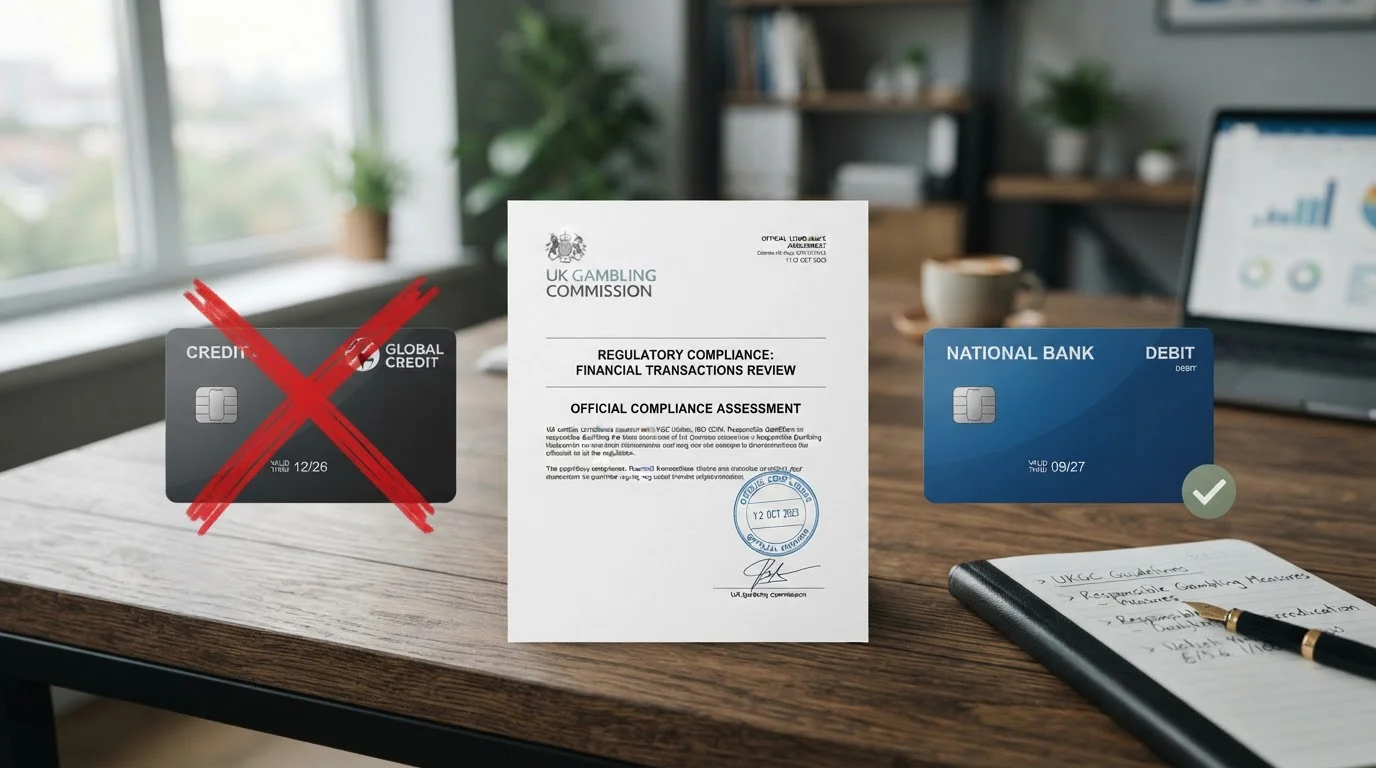
Credit cards were once the default deposit method at UK online casinos. That changed on 14 April 2020, when the UKGC banned credit card deposits under LCCP 5.1.
The UKGC introduced the ban to tackle problem gambling funded by borrowed money. Research cited by the UKGC found that 22% of online gamblers using credit cards were classed as problem gamblers. Credit cards enabled players to gamble beyond their means by borrowing money, accumulating debt, and spiralling into financial harm. The regulator determined that cutting off credit-based gambling would reduce problem gambling rates.
The ban applies to all UKGC-licensed operators, covering Visa, Mastercard and American Express credit cards. Debit cards remain legal because the funds come directly from the player’s bank account, not borrowed credit. Prepaid cards remain legal because they represent pre-loaded funds, not credit.
The ban extends to e-wallet funding. The LCCP binds the casino, not the wallet: a licensed operator must not accept a deposit made through an e-wallet or other payment service if it is funded by a credit card. In practice, PayPal, Skrill, Neteller and other wallets block credit card top-ups for gambling, so you cannot load your PayPal balance with a credit card and then deposit from PayPal to a casino.
Some sites licensed outside Great Britain still advertise credit card deposits. They do not hold UKGC licences and are not bound by LCCP provisions, so none of the UK protections apply: there is no UK-based dispute resolution, no UKGC safer gambling tools, no link to GAMSTOP self-exclusion and no guarantee that a foreign regulator will enforce fair play. Cashier Atlas does not cover these sites.
The ban has no end date and applies to all UKGC-licensed operators, and there is no sign the UKGC will reverse it. If you previously used a credit card at UK casinos, the alternatives are debit cards (universal acceptance), e-wallets (faster withdrawals) or Open Banking (instant deposits).
Why can’t I use my credit card at UK online casinos?
The UK Gambling Commission banned credit card gambling from 14 April 2020 through a change to its licence conditions, to reduce harm from gambling with borrowed money. Only debit cards and prepaid cards are permitted, and licensed casinos must also refuse e-wallet deposits funded by a credit card.
How to Choose the Right Payment Method
Different priorities call for different payment methods. This section maps four common priorities to the methods that best serve each one.
Instant Deposits
Need your funds to clear immediately so you can start playing without waiting? These methods credit your balance on the spot:
Debit cards (Visa, Mastercard): instant clearing, accepted everywhere, £1 to £10 minimums depending on operator. The default choice for instant access.
E-wallets and mobile wallets (PayPal, Skrill, Apple Pay, Google Pay): instant clearing. PayPal and Skrill need an account set up first, and Skrill must be topped up before you pay; Apple Pay and Google Pay simply draw on the debit card already in your phone.
Trustly / Open Banking: instant clearing via direct bank connection. No separate wallet or card needed. Minimum typically £10.
Boku / pay by mobile: instant clearing charged to your phone bill. Maximum £30 per transaction. Deposit-only.
Prepaid vouchers (Paysafecard): instant clearing if you have a voucher. You must purchase the voucher with cash at a retail location first, then enter the PIN in the casino cashier.
Traditional bank transfer is the only common method that is not instant. The payment itself travels quickly, but the casino has to credit it manually, which can take up to three working days. If you need to play immediately, choose another method.
Fastest Withdrawals
Chasing speed above all? These are the methods that get winnings back to your account quickest:
PayPal: 12 to 24 hours typical from request to PayPal balance, and sometimes under an hour at the quickest operators. Then instant or one working day from PayPal to your bank depending on your bank’s PayPal integration.
Trustly / Open Banking: typically under one hour from casino approval to your bank account. The fastest option at the best operators.
Skrill and Neteller: typically 24 to 48 hours from request to wallet balance. Then an instant transfer to your bank (£1 fee for Skrill) or a free standard transfer taking one to two working days.
Apple Pay and Google Pay withdraw to the underlying debit card, so withdrawal speed matches debit cards: two to three working days, not as fast as PayPal or Trustly.
Debit cards: two to three working days typical from casino approval. Slower than e-wallets but faster than traditional bank transfers.
Traditional bank transfer: three to seven working days. The slowest withdrawal option.
Boku and mobile payments do not support withdrawals. You must use a different method to cash out.
Lowest Minimum Deposits
On a tight budget, the floor you can deposit at swings more than you would expect from one method to the next:
£1 minimum: DragonBet accepts £1 deposits via debit card and Apple Pay, one of the lowest floors in the UK market. Most casinos set higher minimums, so £1 access is rare.
£5 minimum: The most common minimum at major UK casinos. bet365, Paddy Power, William Hill, Ladbrokes and Betfred all accept £5 deposits via debit cards, PayPal, and Apple Pay. This is the practical minimum for most players.
£10 minimum: Common for Trustly / Open Banking, Skrill, Neteller, MuchBetter, and some debit card operators. Still accessible for casual players.
£5–£10 minimum for Boku: Pay-by-mobile floors are low, but watch the processing fees some casinos add, which take a bigger share of a small deposit.
Manual bank transfer is the one to avoid for small deposits: minimums range from £10 at some operators to £100 at bet365, the highest floor of any common method.
What is the lowest minimum deposit at UK online casinos?
The lowest minimum deposit we have found is £1, available at DragonBet for debit card and Apple Pay payments. Most UKGC-licensed casinos set a £5 minimum for debit cards, PayPal and Apple Pay, while Trustly, Skrill and Neteller typically require £10. Qualifying amounts for welcome offers are often higher.
Most Private Methods
To keep your bank and card details out of the casino’s hands entirely, a few options stand out:
Boku / pay by mobile: The casino never sees your bank account, card number, or financial details. The charge appears on your phone bill as the casino name, but the payment flows through the mobile network rather than your bank. Deposit-only (withdrawals still need a card or bank account).
Paysafecard / prepaid vouchers: You purchase a voucher with cash at a retail location, then enter the PIN in the casino cashier. The casino never sees your bank or card details, although your account is still identity-verified like any other. Deposit-only (withdrawals need a card or bank account).
Trustly / Open Banking: The casino never stores your bank details. You log in to your online banking directly to authorise each payment, and Trustly facilitates the transfer without sharing your credentials. Trustly itself sees your bank account for the transaction, but the casino does not.
PayPal, Skrill, Neteller, Apple Pay: With an e-wallet, the casino sees your wallet email or mobile number but not your bank account or card details; with Apple Pay, it receives a tokenised payment rather than your real card number. Either way, the wallet or mobile payment service handles the link to your bank.
Debit cards: The casino stores your card number for deposits and withdrawals. The least private option, as the casino sees your card details and processes transactions through the card network.
| Priority | Recommended Methods | Why It Works | Typical Limits |
|---|---|---|---|
| Instant Deposits | Debit cards, PayPal, Trustly, Apple Pay, Boku | Clear in seconds; no waiting | £1–£10 min (debit/PayPal/Apple Pay); £10 min (Trustly); £5–£30 (Boku) |
| Fastest Withdrawals | Trustly, PayPal, Skrill, Neteller | Under 1 hour (Trustly); 12–24 hours (PayPal); 24–48 hours (Skrill/Neteller) | £5–£10 min deposits |
| Lowest Minimums | Debit cards (£1 at DragonBet), Apple Pay (£1 at DragonBet), PayPal (£5 standard) | Accept smallest deposits | £1–£5 typical |
| Privacy | Boku, Paysafecard, Trustly, PayPal | Casino never sees bank/card details | £5–£30 (Boku); £10–£100 (Paysafecard); £10 (Trustly); £5 (PayPal) |
Are there any fees for deposits or withdrawals at UK casinos?
Most UKGC-licensed casinos charge players nothing for deposits or withdrawals. The exceptions are mostly provider fees: Skrill charges 1.45% for currency conversion and £1 for instant bank withdrawals, Neteller 1.50% for conversion, and some casinos add a Boku processing fee. Debit cards, PayPal deposits, Apple Pay and Trustly are free.
Withdrawal Times: What to Expect
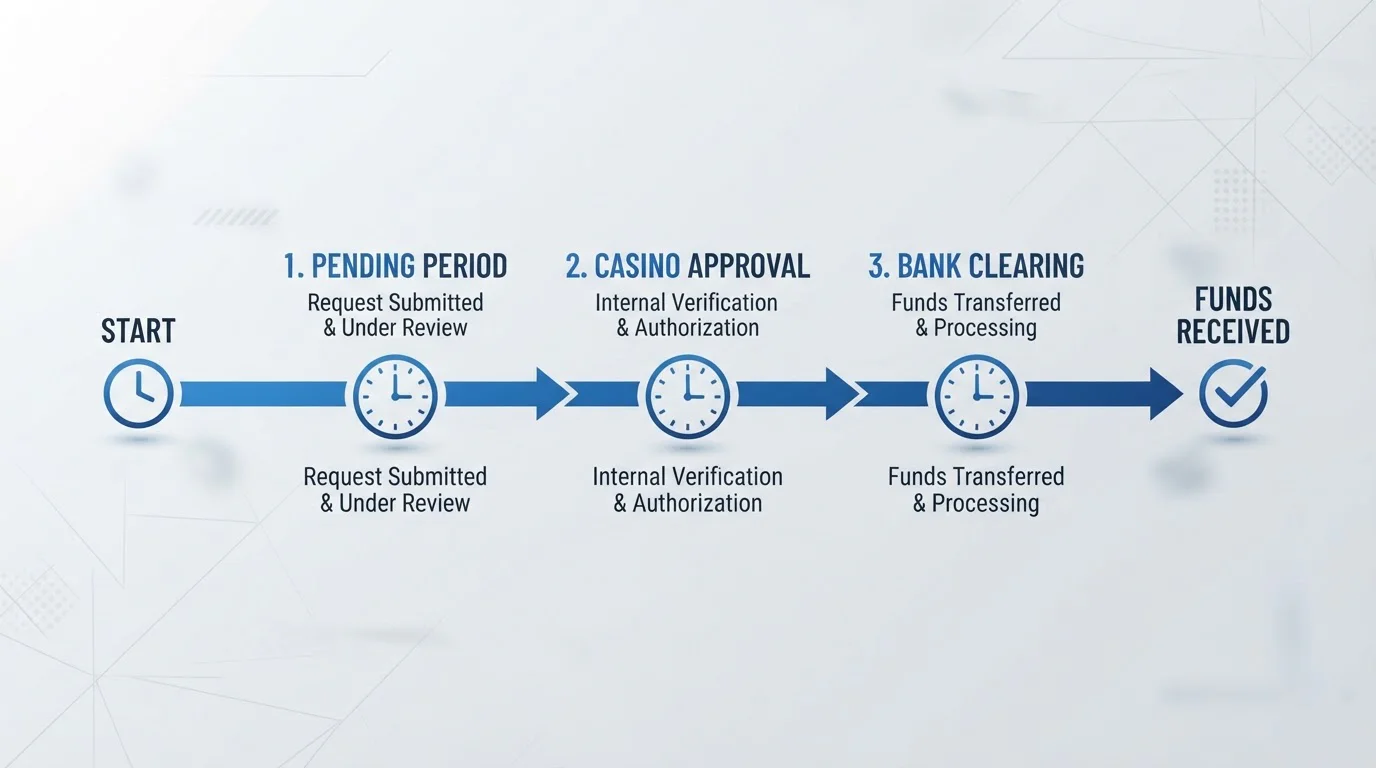
Withdrawal timing has three stages: casino pending period, casino approval, and payment provider clearing time. Understanding each stage helps set realistic expectations for when your money will reach your bank account.
Verification and First Withdrawal Delays
Since May 2019, UKGC operators must verify your age and identity before you can deposit or gamble, so the main identity checks happen when you register. Most are completed automatically against electoral roll and credit reference data. If they fail, the casino asks for documents straight away: photo ID, such as a passport, driving licence or national ID card, and proof of address, such as a bank statement, utility bill or council tax bill dated within the last three months.
A first withdrawal can still take longer than later ones because the casino may need to confirm that the payment method is yours. Typical evidence is a photo of the debit card you deposited with (showing the first six and last four digits, with the middle digits masked), a screenshot of your e-wallet account, or a bank statement showing your account number. Until these checks are complete, your withdrawal stays pending.
Once your payment method is confirmed, routine withdrawals usually clear without further document requests. The casino may ask for updated documents if your address changes, if you add a new payment method or if a large payout triggers source-of-funds or anti-money-laundering checks. Uploading payment-method evidence as soon as you have deposited is the simplest way to keep your first payout on schedule.
Do I need to verify my identity before withdrawing?
Your identity and age are verified before you can deposit at all, not at the point of withdrawal. Before paying out, a casino may still ask you to prove you own the card, e-wallet or bank account receiving the money. Larger withdrawals can also trigger source-of-funds checks, so keep recent bank statements to hand.
Processing Stages: Pending, Approval, and Clearing
After you request a withdrawal, three stages determine when the money reaches you.
Casino pending period (0 to 48 hours). Some casinos place withdrawal requests in a pending state for a window of time, typically 24 to 48 hours. During this period, you can cancel the withdrawal and return the funds to your casino balance. This pending period is optional; not all casinos implement it. Fast-pay casinos skip this stage and move directly to approval.
Casino approval (instant to 24 hours). The casino reviews your withdrawal to ensure it complies with bonus wagering terms, safer gambling checks and anti-money-laundering rules. Approval is often automated for routine withdrawals, while large withdrawals or accounts flagged for additional checks go to manual review. Approval typically takes a few hours; at fast casinos it happens instantly once any pending period expires.
Payment provider clearing time (method-dependent). Once the casino approves the withdrawal and sends funds to the payment provider, clearing time depends on the method:
- PayPal: instant to 24 hours
- Trustly / Open Banking: instant to 1 hour
- Skrill / Neteller: near-instant to the wallet balance (then to your bank: instant with a £1 fee at Skrill, or 1–2 working days free)
- Debit cards: 1–5 working days (typically 2–3)
- Traditional bank transfer: 3–7 working days
Total time = pending + approval + clearing. A casino with a 24-hour pending period, instant approval, and a PayPal withdrawal might deliver funds to your PayPal balance in 25 hours total. A casino with no pending period, instant approval, and Trustly might deliver funds to your bank in under one hour. A casino with a 48-hour pending period, 24-hour manual approval, and a debit card withdrawal might take five working days total.
| Method | Casino Pending | Casino Approval | Provider Clearing | Total Time Range |
|---|---|---|---|---|
| PayPal | 0–48 hours | Instant–24 hours | Instant–24 hours | Under 1 hour–4 days |
| Trustly | 0–48 hours | Instant–24 hours | Instant–1 hour | Under 1 hour–3 days |
| Skrill | 0–48 hours | Instant–24 hours | Near-instant | Under 1 hour–3 days |
| Neteller | 0–48 hours | Instant–24 hours | Near-instant | Under 1 hour–3 days |
| Apple Pay (debit) | 0–48 hours | Instant–24 hours | 1–5 working days | 1 working day–about 1.5 weeks |
| Debit cards | 0–48 hours | Instant–24 hours | 1–5 working days | 1 working day–about 1.5 weeks |
| Traditional bank transfer | 0–48 hours | Instant–24 hours | 3–7 working days | 3 working days–about 2 weeks |
| Boku | N/A | N/A | N/A | Deposit-only |
The fastest operators skip or minimise the pending period, process approvals instantly for routine withdrawals, and use fast payment methods (PayPal, Trustly). At the quickest operators, an e-wallet payout can reach your PayPal balance in under an hour from the withdrawal request, while traditional bank transfers commonly take four working days or more.
Working days matter for card and bank transfer withdrawals. If you request a debit card withdrawal on Friday afternoon, the casino might approve it Monday, send it to the card network Monday evening, and the funds clear Wednesday or Thursday. Weekends and UK bank holidays do not count as working days. E-wallets and Trustly operate seven days a week, so weekend withdrawals can clear on Saturday or Sunday, making them faster in practice even when the nominal clearing time is similar.
Minimum Deposits Across Payment Methods
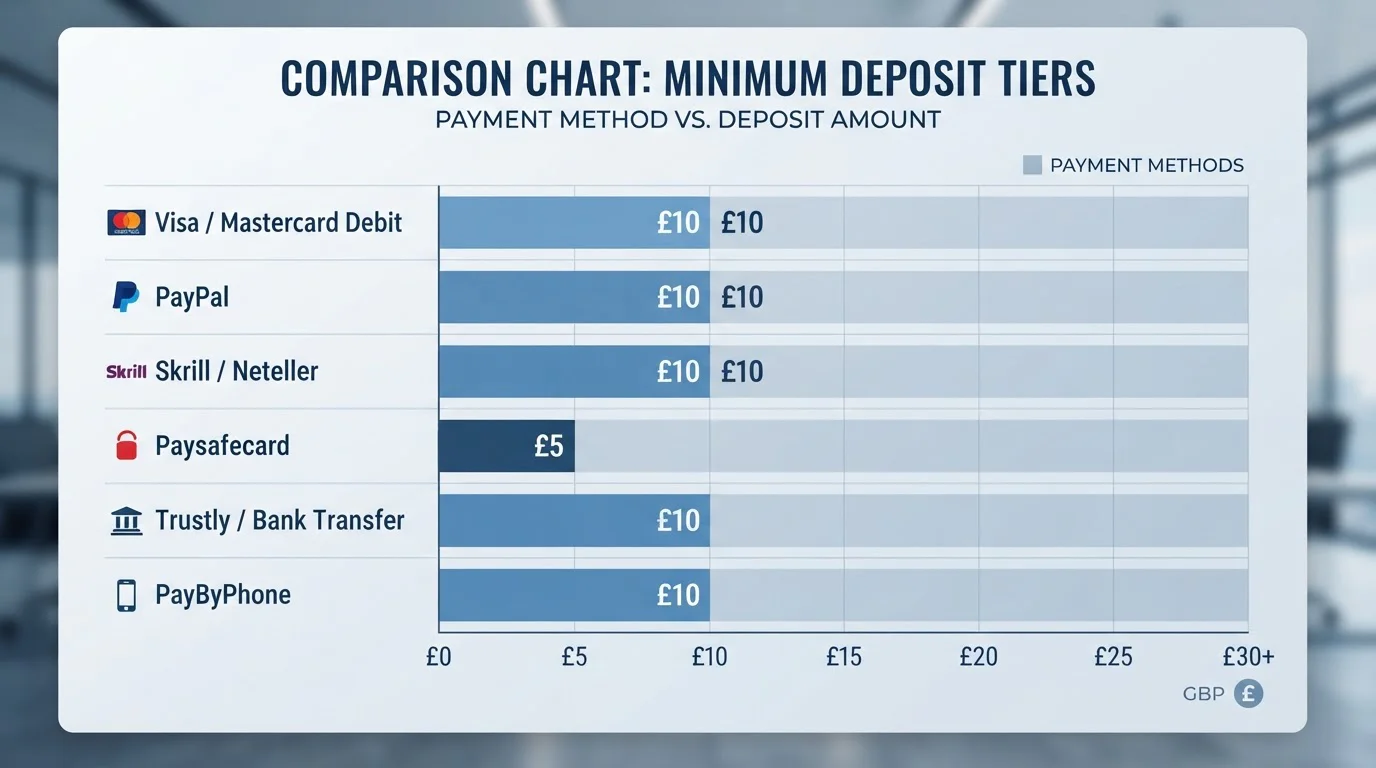
Minimum deposit requirements vary by payment method and operator. This section summarises the floors you will encounter at UKGC-licensed casinos in 2026.
£1 minimum (rare): DragonBet accepts £1 deposits via debit card and Apple Pay, the lowest minimum we have found in the UK market. Few other operators go this low. If £1 access matters, DragonBet is the option, though the casino itself is smaller and less established than major brands.
£5 minimum (most common): The industry standard at major UK casinos. bet365, Paddy Power, William Hill, Ladbrokes, Betfred, Coral, Grosvenor, and most large operators set a £5 minimum for debit cards, PayPal, and Apple Pay. If you are depositing at a well-known casino, expect a £5 floor for these methods.
£10 minimum (common for e-wallets and banking): Trustly / Open Banking, Skrill, Neteller, MuchBetter, and Google Pay typically require £10 minimums.
£5 to £30 range (Boku): Mobile payments via Boku have low minimums (£5 or £10 depending on the casino) but cap at £30 per transaction. For most players, that £30 ceiling matters more than the floor.
£10 to £100 (traditional bank transfer): Manual bank transfer has the widest spread of any method. Many operators accept £10 to £20, but bet365 requires £100, the highest minimum of any common method, so check the cashier before choosing this route for a small deposit.
| Method | Typical Minimum | Lowest Found | Operator Examples |
|---|---|---|---|
| Debit cards | £5 | £1 | £1 at DragonBet; £5 at bet365, Paddy Power, William Hill |
| PayPal | £5 | £5 | £5 at bet365, Paddy Power, William Hill, Betfred |
| Skrill | £10 | £5 | £5 at some operators; £10 typical |
| Neteller | £10 | £5 | £5 at some operators; £10 typical |
| Apple Pay | £5 | £1 | £1 at DragonBet; £5 at bet365, Paddy Power, William Hill |
| Google Pay | £10 | £5 | £5 at some operators; £10 typical |
| Trustly / Open Banking | £10 | £10 | £10 standard |
| Boku | £5–£10 | £5 | £5 at some operators; £10 at others; £30 max |
| Traditional bank transfer | £10–£100 | £10 | £100 at bet365; £10–£20 at others |
Minimum deposit requirements affect welcome bonus eligibility. Many UK casino bonuses require a qualifying deposit of £10 or £20. If the bonus requires £10 and your payment method has a £5 minimum, you must still deposit at least £10 to claim it. Since 19 January 2026, wagering requirements on UK bonuses have been capped at 10 times the bonus amount, so a £20 bonus can require no more than £200 of wagering.
Which payment methods qualify for welcome bonuses?
Debit cards, PayPal, Apple Pay, Google Pay, Trustly and traditional bank transfers typically qualify for welcome bonuses at UK casinos. Skrill, Neteller and MuchBetter deposits are usually excluded, and Boku and Paysafecard often are too. Exclusions are listed in each offer’s terms, so check them before you choose how to deposit.
Prepaid and Alternative Options
Prepaid vouchers and alternative payment methods cover niche use cases: maximum privacy, no bank account required, or preference for cash-based deposits.
Paysafecard is a prepaid voucher you purchase with cash at retail locations (convenience stores, petrol stations, supermarkets). Each voucher has a 16-digit PIN. You select Paysafecard in the casino cashier, enter the PIN, and the voucher amount is credited to your casino balance instantly. The casino never sees your bank details or card number, although your casino account is still fully identity-verified under UKGC rules, exactly as with every other method.
Vouchers are available in denominations from £10 to £100. You can combine multiple PINs in a single deposit if your purchase amount exceeds one voucher’s value. Paysafecard is deposit-only; you cannot withdraw to a voucher. Withdrawals must go to a debit card, e-wallet, or bank account.
Paysafecard is accepted at select UKGC-licensed casinos, fewer than 20 as of 2026. Availability is limited compared to debit cards or PayPal. Minimum deposits are typically £10 to £20. Paysafecard charges no player fees for deposits, though purchasing a voucher at a retail location may involve a small markup depending on the retailer.
AstroPay is a prepaid virtual card service. You fund an AstroPay account via bank transfer or local payment methods, then generate a virtual card with a 16-digit number to use for deposits. AstroPay is accepted at a handful of UKGC-licensed casinos, making it a niche option. It functions similarly to Paysafecard but uses a virtual card interface rather than physical vouchers.
Klarna is best known for buy-now-pay-later, but that credit product cannot be used for gambling. A few casinos accept Klarna’s instant bank payment option instead, which works like any other Open Banking deposit and draws on your own bank balance. Availability is too limited to recommend it as a primary deposit method.
These alternative methods serve specific needs: if you want to deposit with cash and keep bank details out of the cashier, Paysafecard works. For most UK players, debit cards, e-wallets, or Open Banking offer better availability, lower minimums, and faster processing.
What About Cryptocurrency?
In practice, cryptocurrency payments (Bitcoin, Ethereum, Litecoin, Dogecoin and others) are not accepted at UKGC-licensed casinos. The Gambling Commission does not ban crypto outright, but licensed operators must meet strict anti-money-laundering and source-of-funds requirements, and licensed casinos do not offer crypto in their cashiers.
Sites that promote crypto payments to UK players typically hold a licence from another jurisdiction, such as Curaçao, or no licence at all. Offering gambling to consumers in Great Britain without a UKGC licence is illegal, and these sites sit outside every UK safeguard:
- No UK-based dispute resolution or complaints process
- No UKGC safer gambling tools (deposit limits, reality checks) and no link to GAMSTOP self-exclusion
- No guarantee of fair play, payout reliability, or operator accountability under UK law
- Verification and withdrawal practices that do not follow UK standards, with little recourse if a payout is refused
If you have self-excluded through GAMSTOP, the exclusion exists to protect you, and a site outside the UK licensing system does not change that. Free, confidential support is available from GamCare through the National Gambling Helpline on 0808 8020 133, and GAMSTOP can answer questions about your exclusion directly.
Like the rest of Cashier Atlas, this guide covers only UKGC-licensed operators. If the appeal of crypto is speed, Open Banking via Trustly and e-wallets such as PayPal already deliver same-day withdrawals at licensed casinos, together with full UK consumer protection, safer gambling tools and access to independent dispute resolution.
Minimum Deposit Casinos UK 2026 – £1, £5 and £10 Guides
Content created by the «Cashier Atlas» team